What Are the Leading Hotel Lobby Design Trends for 2026?
Hotel lobbies in 2026 are no longer transition zones between the entrance and the elevator. They are revenue-generating spaces engineered to extend guest dwell time, attract local visitors, and communicate brand identity within the first seven seconds of arrival.1
Three shifts define the 2026 lobby: a move toward nature-rooted color palettes, a preference for durable and sustainable materials over disposable aesthetics, and the transformation of lobby layouts into multifunctional “third spaces.” Each shift carries direct implications for furniture selection, material sourcing, and spatial planning.
What Color Palettes Are Hotels Using in Lobbies This Year?
The dominant direction is warmth with restraint. Deep greens, warm neutrals, and soft whites are displacing the gray-on-gray schemes that characterized much of the previous decade.
Pantone’s 2026 Color of the Year is Cloud Dancer (11-4201), a warm white selected as a response to digital overstimulation and what Pantone describes as a cultural need for reset.2 This marks the first time Pantone has chosen a shade of white, signaling that calm, uncluttered environments have become a baseline expectation rather than a stylistic choice. The global wellness economy, now valued at $6.8 trillion according to the Global Wellness Institute, reinforces this trajectory.2
At the same time, Dunn-Edwards selected Midnight Garden, a deep forest green, as its 2026 color. Sherwin-Williams chose Universal Khaki, a warm neutral between beige and taupe.3 Together, these three selections map a palette rooted in natural tones: earthy greens, soft creams, and organic warm neutrals.
Color psychology research supports deliberate zoning within lobbies. Warm tones (terra cotta, muted gold) encourage socialization and energy in communal seating areas. Cooler tones (sage, deep green) promote calm in lounge and waiting zones.1 Designers in 2026 are applying this principle to create distinct emotional zones within a single open-plan lobby.
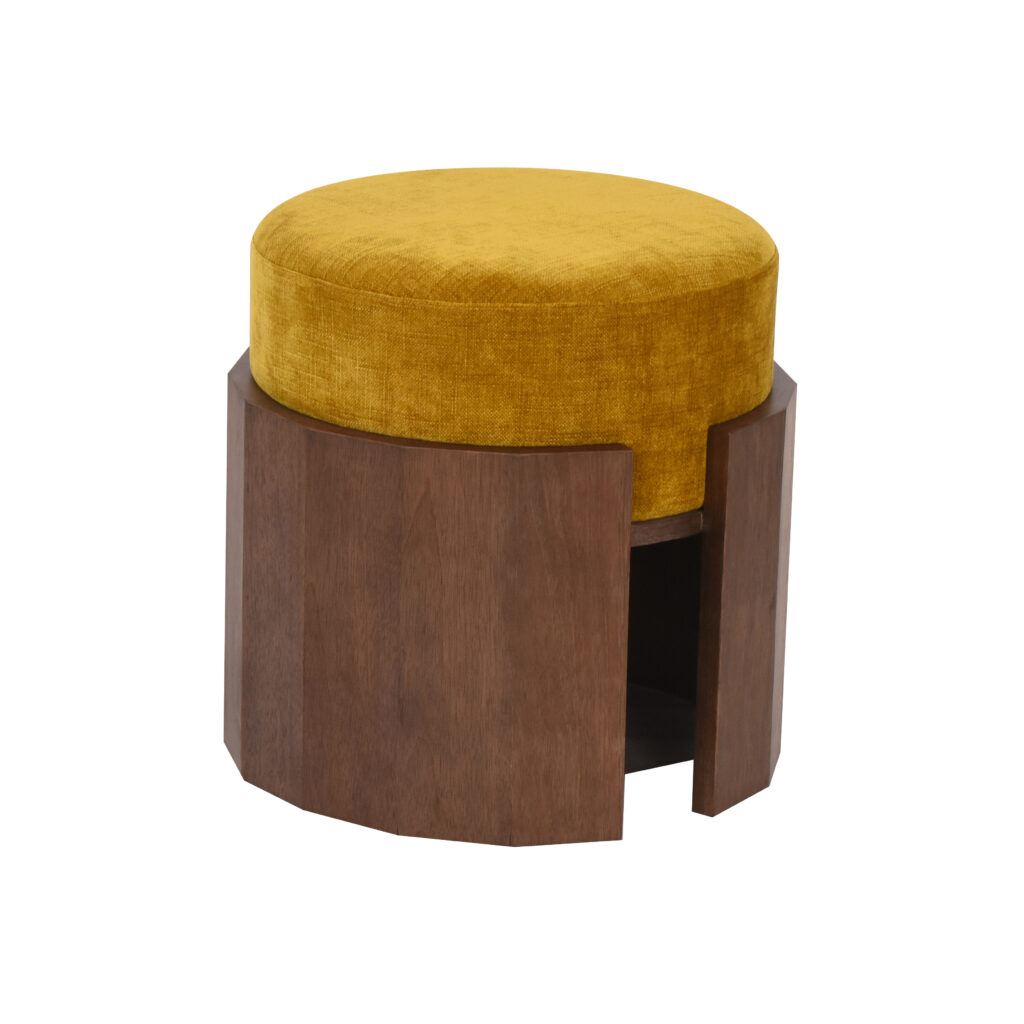
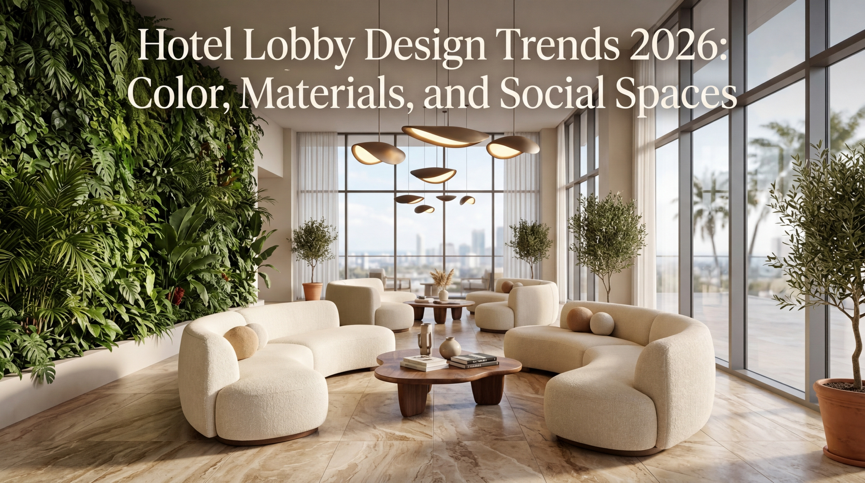
In practice, this translates to pairing a deep green accent wall or upholstery fabric with warm walnut wood furniture, cream-colored bouclé textiles, and bronze metallic accents. This combination photographs well under natural light, supports the biophilic design movement, and avoids the short lifecycle of novelty color choices.3
Why Are Hotels Replacing Traditional Reception Desks with Living Rooms?
Because guest behavior has shifted. Remote work, bleisure travel (the blending of business and leisure trips), and longer average stays have created demand for lobby spaces that serve multiple functions throughout the day.
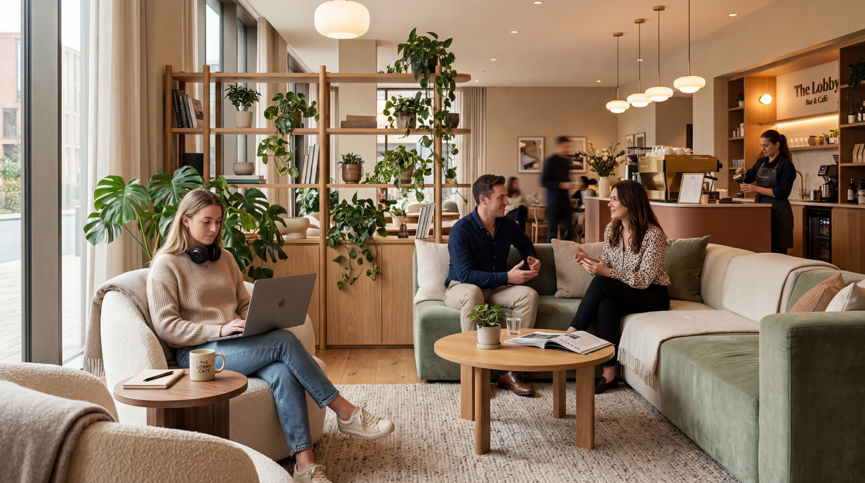
The concept draws on sociologist Ray Oldenburg’s “third place” theory: spaces that are neither home (first place) nor workplace (second place) but serve as community anchors for informal gathering and unstructured interaction.4 In 2026, hotel lobbies are being designed to fill this role, functioning as co-working hubs in the morning, casual dining spaces at midday, and social lounges in the evening.
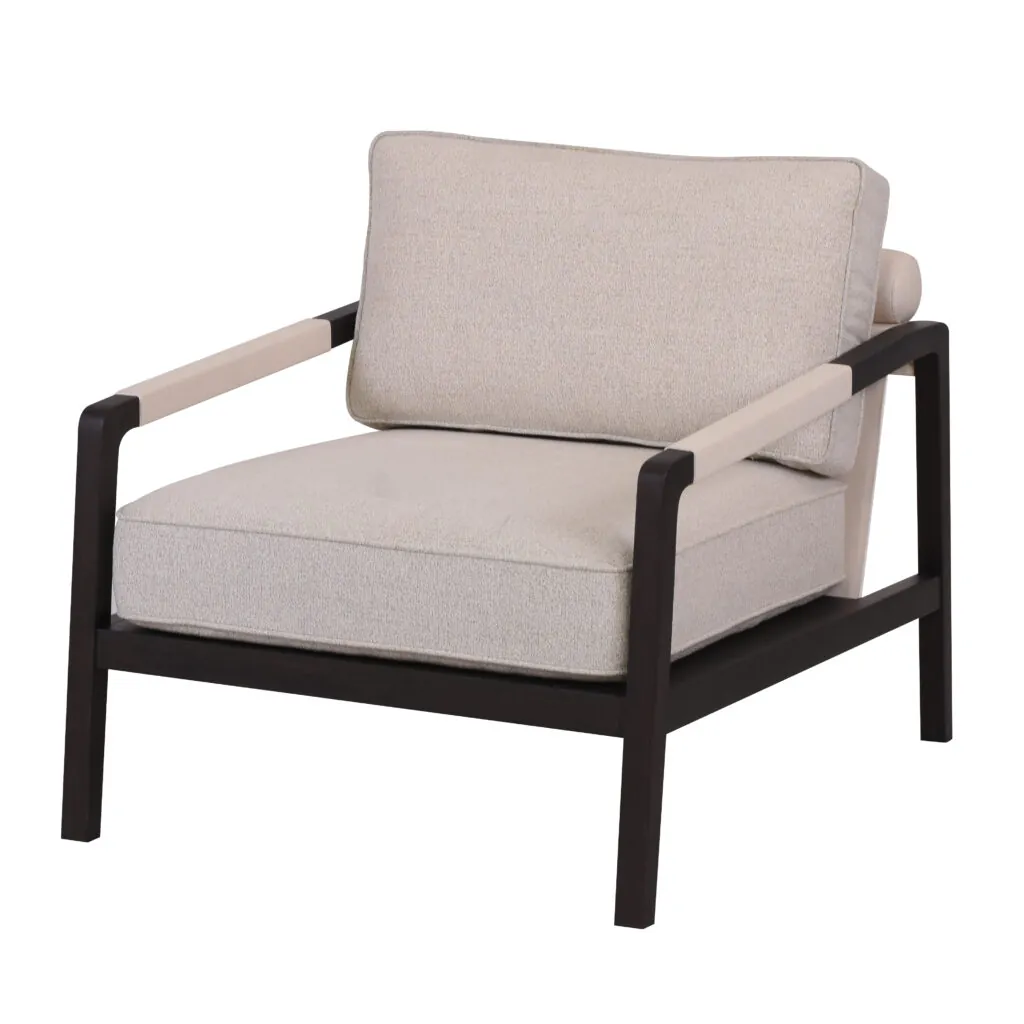
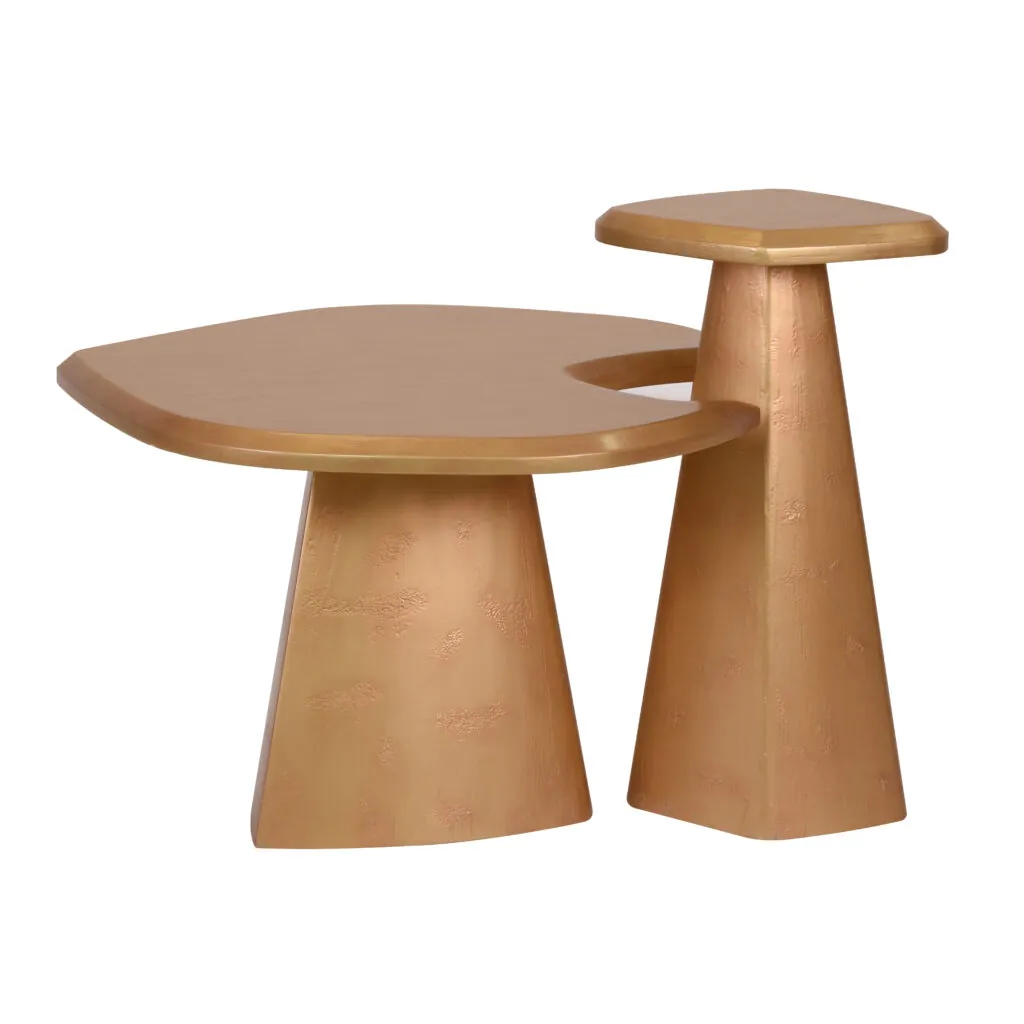
This requires modular furniture systems that can be reconfigured without dedicated staff effort. Movable lounge chairs, lightweight tables, and sectional sofas with swappable configurations allow the same 200 m² lobby to serve a business traveler working on a laptop at 9 AM and a group meeting for drinks at 9 PM.
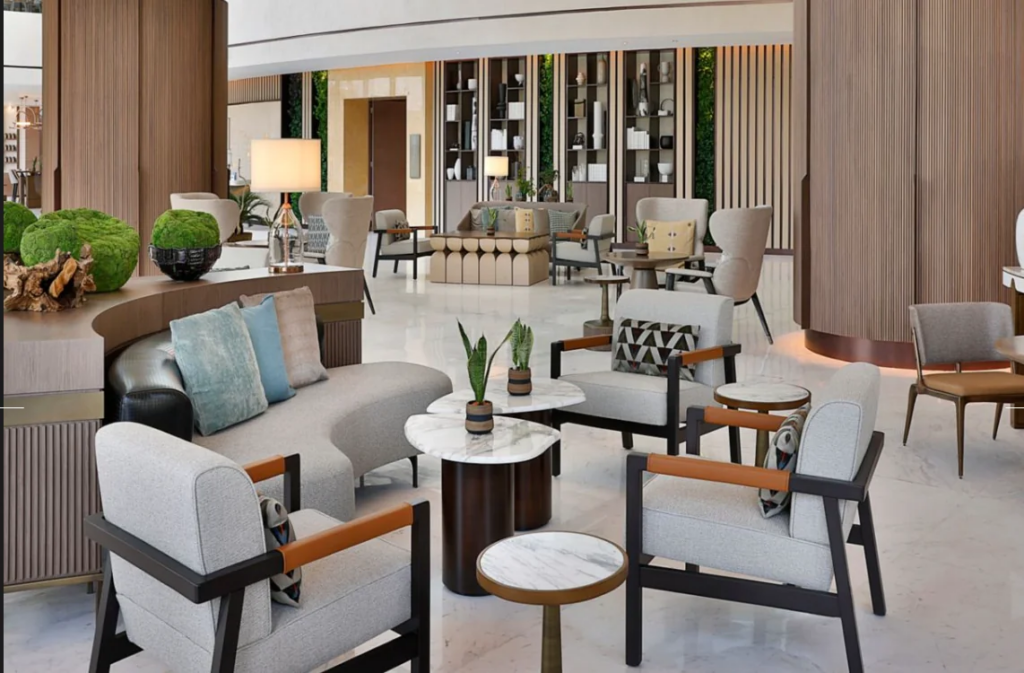
The revenue impact is measurable. A boutique hotel in Singapore that replaced fixed linear sofas with curved modular seating units reported an 18% increase in guest dwell time and a 12% increase in café revenue.5 Hotels adopting hybrid lobby layouts consistently report stronger food and beverage performance alongside higher local community engagement.6
Some properties have removed the reception desk entirely, replacing it with a “living room” model where staff check guests in via tablet while seated on a sofa.1 This approach reduces the perceived formality of arrival and increases the usable social area within the lobby footprint.
Which Materials Are Gaining Ground in Hotel Lobby Interiors?
Durability and sustainability now carry equal weight with visual appeal. Designers in 2026 are selecting lobby materials based on total cost of ownership (the sum of initial cost, maintenance expense, and replacement cycle) rather than upfront price alone.6
Natural materials dominate the specification sheets: solid wood (particularly walnut and oak), natural stone, and tactile woven textiles. These selections align with the biophilic design movement and meet the expectations of LOHAS (Lifestyles of Health and Sustainability) travelers, a growing segment that actively chooses properties with visible environmental commitments.6
FSC-certified wood sourcing has moved from a differentiator to a baseline specification for international hotel brands. Low-VOC (volatile organic compound) finishes and formaldehyde-compliant composite boards meeting CARB Phase II standards are now standard requirements in new builds and major renovations across North America and Europe.
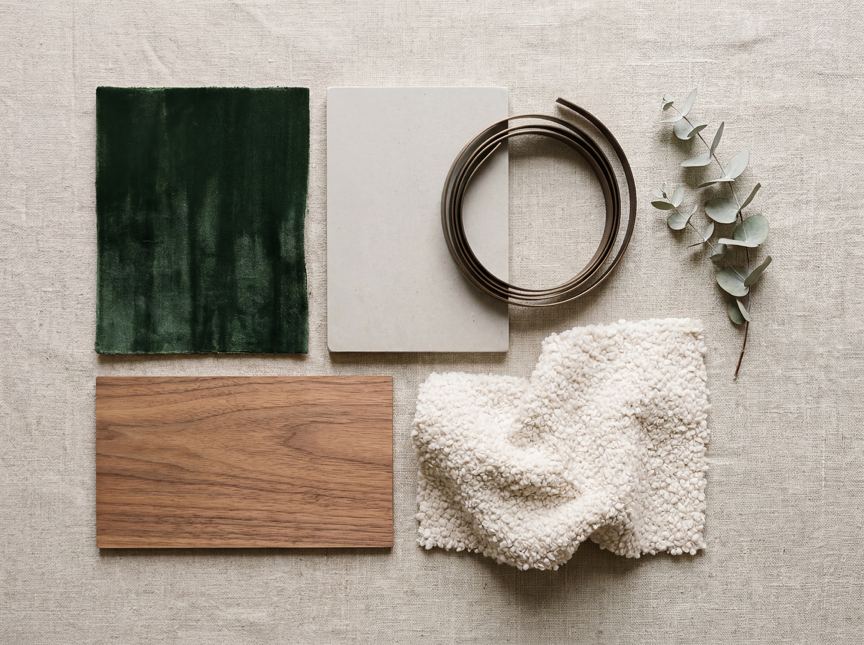
The defining material shift of 2026 is texture over pattern. Where the previous decade favored flat, glossy surfaces, current lobbies prioritize tactile richness: deeply grained wood, hand-finished stone, ribbed fabric, and matte metallic hardware. This reflects a broader cultural move toward physical, sensory experiences as a counterbalance to screen-dominated daily life.
Solid wood furniture with proper joinery provides a 12-to-15-year service life in commercial hospitality settings, while engineered alternatives typically require replacement within 7 to 10 years.7 For hotel operators evaluating long-term return, material selection at the procurement stage directly affects the replacement cycle and total lifecycle cost.
How Does Biophilic Design Affect Guest Behavior in Lobbies?
The effect is quantifiable. Research by Terrapin Bright Green found that 36% of guests chose to spend time in hotel lobbies that incorporated biophilic elements (living plants, natural light, water features, organic materials), compared to only 25% in conventional lobbies without these features. Additional studies suggest that hotel rooms and public spaces with strong visual connections to nature command a 12% to 16% price premium.8
The practical toolkit for biophilic lobby design includes living green walls, indoor trees or clustered planting, maximized window area for natural daylight, natural stone or wood flooring, and water features at varying scales. Even a small tabletop fountain contributes to both the acoustic environment and the visual sense of nature within an enclosed space.
For urban hotels with limited access to outdoor views, material selection carries the biophilic load. Furniture and surfaces featuring natural wood grain, stone veining, and organic textile textures create a perceived connection to nature even in a fully interior ground-floor lobby.
The business case for biophilic lobby investment extends beyond daily guest experience. Properties positioned within the wellness travel segment tap into a $6.8 trillion global spending category that continues to grow year over year.2
What Does This Mean for Hotel Lobby Furniture Selection?
These converging trends point to a consistent set of requirements: lobby furniture in 2026 needs to be modular in configuration, sustainably sourced, texturally rich in materiality, and engineered to endure high-traffic commercial use for 7 to 10 years without visible degradation.
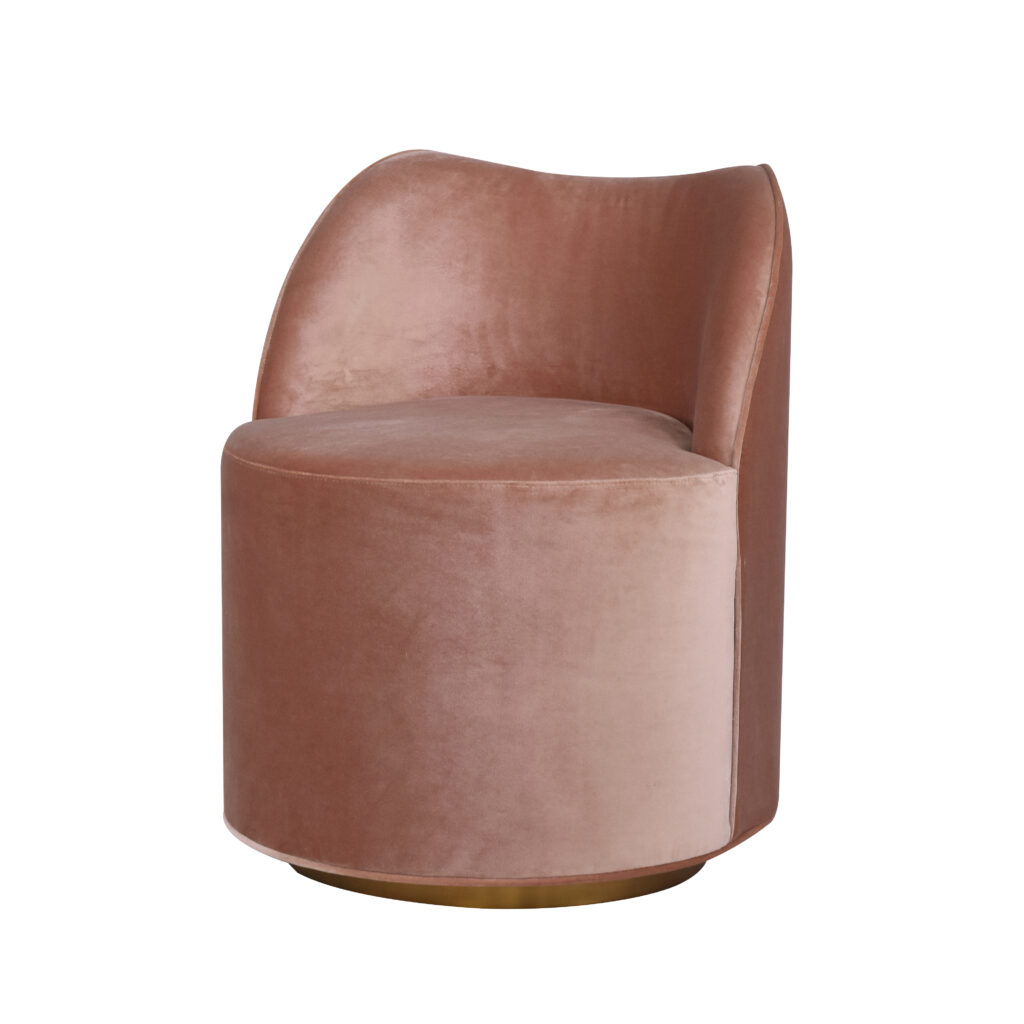
Curved silhouettes are replacing angular forms across seating categories. Sectional and modular systems are replacing fixed arrangements. Natural wood, stone, and woven materials are replacing synthetic laminates. And manufacturers who offer design consultation alongside production capability are replacing commodity suppliers who build strictly to print.
This shift is moving the furniture manufacturer’s role earlier in the design timeline. The supplier’s material library, prototyping speed, and understanding of hospitality-grade durability standards now influence what the interior designer can realistically specify. Procurement teams that engage their manufacturing partner during the concept phase, rather than after design freeze, consistently report fewer specification changes during production and shorter overall project timelines.
Gainwell Furniture, with 30 years of experience supplying lobby, guestroom, and public area furniture for properties including The Venetian Macao, Marina Bay Sands, and Waldorf Astoria, maintains a 86-person R&D team and collaborates with material partners such as Sherwin-Williams to translate evolving design trends into production-ready specifications. FSC certification, ISO 14001 environmental management, and CARB compliance support the sustainability credentials that 2026 hotel projects require.
About the Author: This article is published by Gainwell Furniture (Zhongshan Gainwell Furniture Co., Ltd.), a custom hospitality furniture manufacturer and hotel design partner since 1995. With production bases in Guangdong (China), Binh Dong (Vietnam), Gainwell provides full-scope FF&E solutions for five-star hotels worldwide, from design consultation and prototyping through manufacturing, packaging, global logistics, and on-site installation. Current and past clients include Disney, Marriott, Hyatt, Hilton, Ritz Carlton, Six Senses, and Accor, among others. Learn more at gainwell.com.
References
- “The Ultimate Guide to Hotel Lobby Design: Trends & Concepts 2026.” MingsunGroup, 12 Dec. 2025, www.mingsungroup.com/blog/hotel-lobby-design-guide-2026.html.
- “Pantone Reveals 2026 Color of the Year.” PR Week, 4 Dec. 2025, www.prweek.com/article/1942119/pantone-reveals-2026-color-year.
- Kuester, James. “Where Are We Headed with Colors in 2026?” Hospitality Net, 13 Nov. 2025, www.hospitalitynet.org/opinion/4129751.html.
- “Trends in Third Spaces 2026: Complete Guide.” ACTIU, 18 Feb. 2026, www.actiu.com/en-us/articles/hospitality/trends-in-third-space/.
- “Hotel Room and Lobby Luxury Sofa Design Trends 2025.” AesthedgeWallPanel, 29 Oct. 2025, aesthedgewallpanel.com/hotel-room-and-lobby-luxury-sofa-design-trends-2025/.
- “2026 Hotel Lobby Design Trends.” AesthedgeWallPanel, 4 Feb. 2026, aesthedgewallpanel.com/2026-hotel-lobby-design-trends/.
- “FF&E and OS&E in Hotel Procurement: The Complete Guide for Industry Professionals.” Hongye Furniture Group, 15 Jun. 2025, hysdfurniture.com/news/ffe-and-ose-in-hotel-procurement-the-complete-guide-for-industry-professionals/.
- “Human Spaces 2.0: Biophilic Design in Hospitality.” Interface / Terrapin Bright Green, www.interface.com/content/dam/interfaceinc/interface/global-campaigns/human-spaces/report/human-spaces-2-0/Interface%20Human%20Spaces%20Report_EN.pdf.